US Economic Forecasts 2026: Goldman Sachs vs. JP Morgan
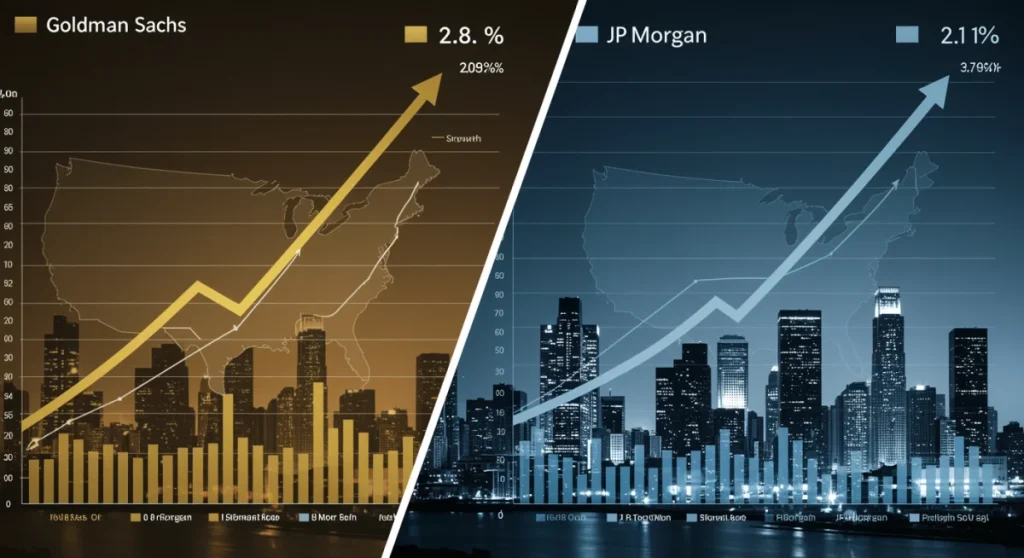
Comparing US economic forecasts for 2026 reveals a notable divergence between Goldman Sachs’ 2.8% GDP growth prediction and JP Morgan’s 2.1%, driven by differing views on monetary policy, consumer spending, and global factors.
As we approach 2026, understanding the nuances of US economic forecasts 2026 from leading financial institutions like Goldman Sachs and JP Morgan becomes increasingly crucial. These projections offer a critical lens through which to view the potential trajectory of the American economy, impacting everything from investment strategies to policy decisions. What drives these differing perspectives, and what do they signify for the year ahead?
Understanding the Economic Projections
Economic forecasting is as much an art as it is a science, relying on complex models, historical data, and a healthy dose of informed judgment. When major players like Goldman Sachs and JP Morgan release their outlooks, the financial world takes note. Their 2026 projections for US GDP growth—2.8% from Goldman Sachs and 2.1% from JP Morgan—represent a significant 0.7 percentage point difference, which can translate into billions of dollars in economic activity.
This variance isn’t merely academic; it reflects fundamental disagreements on how various economic levers will operate and interact over the next year. Investors, businesses, and policymakers often use these forecasts to calibrate their strategies, making the underlying assumptions behind each prediction vital to scrutinize. A higher growth rate typically implies stronger corporate earnings, lower unemployment, and potentially higher inflation, while a more modest growth rate suggests a more subdued environment.
Goldman Sachs’ Optimistic Stance
Goldman Sachs’ 2.8% GDP growth forecast for 2026 suggests a relatively strong and resilient US economy. Their analysis often emphasizes the underlying strengths that could propel sustained expansion. This perspective often hinges on several key factors:
- Robust Consumer Spending: Goldman Sachs frequently points to resilient household balance sheets and a strong labor market as drivers of continued consumer demand, forming the backbone of economic growth.
- Business Investment: Expectations of increased capital expenditure by corporations, fueled by technological advancements and supply chain adjustments, contribute to their optimistic outlook.
- Monetary Policy Accommodation: They might anticipate a Federal Reserve that, while vigilant against inflation, is prepared to adjust interest rates in a manner that supports economic expansion without stifling it.
Their models likely incorporate strong private sector activity and a belief that the economy can absorb and adapt to ongoing global challenges. This outlook generally implies a ‘soft landing’ or even a ‘no landing’ scenario, where the economy avoids a significant downturn and continues its upward trajectory.
JP Morgan’s Measured Outlook
In contrast, JP Morgan’s 2.1% GDP growth forecast for 2026 signals a more cautious, albeit still positive, view of the US economy. This lower projection isn’t necessarily pessimistic but rather reflects a more conservative assessment of potential headwinds and limitations. Their reasoning often focuses on different aspects of the economic landscape:
JP Morgan’s analysis often highlights potential constraints that could temper growth. These might include:
- Persistent Inflationary Pressures: Concerns that inflation, even if moderating, could remain stickier than anticipated, forcing the Federal Reserve to maintain a tighter monetary policy for longer.
- Slowing Global Growth: A weaker global economic environment, particularly in major trading partners, could dampen US export demand and overall economic activity.
- Fiscal Drag: They might anticipate a reduction in government spending or an increase in taxation that acts as a drag on economic expansion.
This perspective often suggests that while the US economy will continue to grow, it will do so at a more moderate pace, potentially facing some structural challenges or external shocks that could limit its upside. Their models may factor in a gradual deceleration as the effects of past stimulus fade and higher interest rates take a fuller toll.
Key Factors Influencing Divergent Projections
The 0.7 percentage point gap between Goldman Sachs and JP Morgan’s 2026 US GDP forecasts stems from differing interpretations and weighting of several critical economic variables. Understanding these differences is crucial for grasping the broader economic narrative.
Monetary Policy Path and Interest Rates
One of the most significant areas of divergence lies in the anticipated path of Federal Reserve monetary policy. Goldman Sachs might foresee a scenario where the Fed achieves its inflation targets more quickly, allowing for earlier or more substantial interest rate cuts that stimulate economic activity. This would provide a tailwind for investment and consumption.
Conversely, JP Morgan might project a more cautious Fed, where inflation proves more stubborn, necessitating higher-for-longer interest rates. Such a scenario would exert continued pressure on borrowing costs for businesses and consumers, inevitably slowing down growth. The timing and magnitude of any rate adjustments are paramount.
Consumer Spending and Labor Market Dynamics
Another major differentiator is the outlook on consumer spending, which accounts for a substantial portion of US GDP. Goldman Sachs’ higher forecast likely assumes continued strength in the labor market, leading to robust wage growth and sustained consumer confidence. They may also believe that household savings accumulated during the pandemic will continue to support spending.
JP Morgan, with its more conservative estimate, might anticipate a gradual cooling of the labor market, potentially leading to slower wage growth or a slight increase in unemployment. This could translate into more cautious consumer behavior and a moderation in spending patterns as households become more sensitive to economic uncertainties. The depletion of excess savings could also play a role in their forecast.
Global Economic Headwinds and Geopolitical Risks
The global economic landscape and geopolitical tensions also cast long shadows over domestic forecasts. Goldman Sachs might factor in a more optimistic scenario for global trade and supply chain recovery, which would benefit US exporters and reduce import costs. They might also see a limited impact from ongoing geopolitical conflicts on US economic stability.
JP Morgan, on the other hand, could be more attuned to potential global headwinds, such as slower growth in China and Europe, which could reduce demand for US goods and services. They might also assign a higher probability to the disruptive effects of geopolitical risks, like trade disputes or energy supply shocks, which could undermine economic confidence and investment. These external factors can significantly impact domestic performance.
Sectoral Performance and Innovation
The performance of specific economic sectors and the pace of technological innovation are also crucial elements in these forecasts. Goldman Sachs’ higher GDP prediction might implicitly assume stronger growth in key sectors, particularly technology and innovation-driven industries. They may anticipate significant productivity gains from advancements in artificial intelligence, automation, and green technologies, which could boost overall economic output.
JP Morgan’s more measured forecast might acknowledge these innovations but perhaps assigns a longer lead time for their widespread economic impact or anticipates regulatory hurdles that could slow their adoption. They might also be more concerned about the potential for certain traditional sectors to face headwinds, such as ongoing supply chain disruptions or shifts in consumer preferences that could affect overall economic momentum. The resilience and adaptability of various industries play a significant role.
Ultimately, the differing views on sectoral strength and the speed of innovation contribute to the varied growth expectations. An economy driven by strong, innovative sectors is likely to demonstrate higher growth potential than one facing more widespread stagnation or transition challenges.
Potential Implications of Each Forecast
The implications of Goldman Sachs’ 2.8% forecast versus JP Morgan’s 2.1% are far-reaching and affect various stakeholders, from individual investors to national governments. Understanding these potential outcomes helps in preparing for different economic environments.
For Investors and Businesses
A higher growth rate, as projected by Goldman Sachs, typically signals a more favorable environment for equities, as stronger GDP growth often translates into higher corporate profits and increased investor confidence. Businesses might be more inclined to expand, hire, and invest in new projects, anticipating robust demand. This scenario could lead to a ‘risk-on’ sentiment in markets, favoring growth stocks and emerging markets.
Conversely, JP Morgan’s 2.1% forecast suggests a more conservative approach might be prudent. While still positive, this growth rate implies a potentially tighter profit margin environment for businesses and possibly more volatility in equity markets. Investors might favor more defensive assets, stable dividend-paying stocks, or fixed-income investments, seeking greater stability in a less buoyant economy. Businesses might focus on cost efficiencies and strategic consolidation rather than aggressive expansion.
For Policymakers and Consumers
Policymakers would interpret the Goldman Sachs forecast as an affirmation of current economic policies, potentially giving them more leeway to address other issues without immediate fear of recession. It could also imply continued pressure on the Federal Reserve to manage inflation, even with stronger growth. For consumers, this scenario suggests a robust job market, potentially rising wages, and greater financial stability.
JP Morgan’s forecast, however, might prompt policymakers to consider more proactive measures to stimulate growth or address potential vulnerabilities. It could also suggest that inflationary pressures might ease more naturally due to slower demand, giving the Fed more flexibility. For consumers, while employment might remain stable, wage growth could be more subdued, and purchasing power might be more sensitive to any lingering inflation. Both forecasts offer valuable insights for strategic planning.
Historical Accuracy and Model Limitations
When evaluating economic forecasts, it’s essential to consider the historical accuracy of institutions like Goldman Sachs and JP Morgan, as well as the inherent limitations of economic modeling. No forecast is perfect, and external shocks or unforeseen developments can significantly alter even the most meticulously crafted projections.
Track Record of Major Institutions
Both Goldman Sachs and JP Morgan have extensive track records in economic forecasting, employing vast teams of economists and sophisticated models. Their forecasts are often influential, guiding market sentiment and corporate strategy. However, their past performance is not a guarantee of future results. Discrepancies between predictions and actual outcomes are common, highlighting the dynamic and unpredictable nature of global economies. Reviewing their historical accuracy on key metrics can provide context, but it doesn’t eliminate future uncertainty.
It’s also important to recognize that these institutions often update their forecasts throughout the year as new data emerges, demonstrating the iterative nature of economic analysis. Initial projections serve as a baseline, subject to continuous refinement.
Inherent Challenges in Economic Modeling
Economic models, no matter how advanced, rely on a set of assumptions about future behavior and policy decisions. These models can struggle to account for:
- Black Swan Events: Unforeseen, high-impact events like pandemics, major geopolitical conflicts, or rapid technological disruptions can instantaneously render previous forecasts obsolete.
- Behavioral Shifts: Changes in consumer and business sentiment, which are difficult to quantify, can significantly impact economic outcomes.
- Policy Responses: The timing and effectiveness of government fiscal and monetary policy responses can introduce variables that are hard to predict consistently.
Therefore, while these forecasts provide valuable frameworks for understanding potential economic paths, they should always be viewed with a degree of critical assessment, recognizing their inherent limitations and the possibility of unexpected developments.
| Key Aspect | Description of Difference |
|---|---|
| GDP Growth | Goldman Sachs predicts 2.8%, JP Morgan 2.1%, showing a 0.7% divergence. |
| Monetary Policy | Goldman Sachs anticipates more accommodative Fed; JP Morgan foresees ‘higher for longer’ rates. |
| Consumer Spending | Goldman Sachs expects robust spending; JP Morgan projects moderation due to labor market cooling. |
| Global Factors | Goldman Sachs more optimistic on global trade; JP Morgan more cautious on global headwinds. |
Frequently Asked Questions About 2026 Economic Forecasts
Goldman Sachs projects a 2.8% GDP growth for the US economy in 2026, indicating a more optimistic outlook. In contrast, JP Morgan forecasts a 2.1% growth rate, suggesting a more tempered yet still positive expansion, primarily due to differing views on monetary policy and consumer resilience.
Goldman Sachs’ more optimistic forecast is largely driven by expectations of resilient consumer spending, strong business investment fueled by innovation, and a belief that the Federal Reserve will manage interest rates to support sustained economic expansion without excessive tightening.
JP Morgan’s more cautious 2.1% forecast stems from concerns about persistent inflationary pressures requiring higher-for-longer interest rates, potential slowing global growth impacting US exports, and a possible moderation in consumer spending as labor market conditions cool down.
A higher forecast (Goldman Sachs) might encourage ‘risk-on’ investment in equities and growth stocks. A more conservative forecast (JP Morgan) could lead investors towards more defensive assets, stable dividend stocks, or fixed-income investments, prioritizing stability in a more moderate growth environment.
No, economic forecasts are not guaranteed. They are based on complex models and assumptions, which can be altered by unforeseen events like geopolitical shifts, natural disasters, or rapid technological changes. Both institutions regularly update their projections as new data becomes available.
Conclusion
The differing US economic forecasts 2026 from Goldman Sachs and JP Morgan—2.8% versus 2.1% GDP growth—underscore the inherent complexities and varied interpretations within macroeconomic analysis. While Goldman Sachs projects a more robust expansion driven by resilient domestic demand and strategic monetary policy, JP Morgan anticipates a more tempered growth path, influenced by persistent inflation concerns and global headwinds. Both perspectives offer valuable insights for stakeholders navigating the economic landscape. Ultimately, these forecasts serve as critical guides, informing strategic decisions while acknowledging the dynamic and often unpredictable nature of the global economy.