U.S. Businesses: Navigating Geopolitical Tensions in 2026

U.S. businesses operating abroad in 2026 must proactively address escalating geopolitical tensions through a practical 4-step framework encompassing robust risk assessment, diversified supply chains, strategic diplomacy, and resilient operational planning.
As the global landscape continues its rapid evolution, U.S. businesses operating abroad face an increasingly complex web of challenges. The ability to effectively address and mitigate the impacts of geopolitical tensions U.S. businesses encounter is no longer optional but a critical determinant of success and sustainability.
Understanding the Evolving Geopolitical Landscape in 2026
The year 2026 presents a unique confluence of geopolitical dynamics that demand careful attention from U.S. businesses with international operations. Shifting power balances, technological rivalries, and regional conflicts are creating an environment of heightened uncertainty. This complexity is compounded by economic nationalism and the weaponization of trade, making traditional market access and operational stability less predictable.
Businesses must move beyond reactive measures and embrace a proactive, analytical stance. Understanding the root causes and potential trajectories of these tensions is the foundational step in developing effective mitigation strategies. It involves continuous monitoring and analysis of international relations, economic policies, and social movements that could impact global trade and investment.
Key Drivers of Geopolitical Volatility
- Great Power Competition: The ongoing strategic competition between major global powers continues to reshape alliances and trade routes, often forcing businesses to choose sides or navigate complex regulatory frameworks.
- Technological Supremacy: The race for dominance in critical technologies like AI, quantum computing, and semiconductors fuels export controls, intellectual property disputes, and data localization requirements.
- Climate Change and Resource Scarcity: Environmental pressures and the competition for essential resources can exacerbate existing tensions, leading to political instability and supply chain disruptions in vulnerable regions.
- Internal Political Divides: Domestic political polarization in various nations can spill over into international relations, affecting trade agreements, investment policies, and the overall business climate.
In conclusion, the geopolitical landscape of 2026 is characterized by multifaceted and interconnected challenges. A deep and continuous understanding of these evolving dynamics is paramount for U.S. businesses to anticipate risks, identify opportunities, and build resilient international strategies.
Step 1: Robust Risk Assessment and Scenario Planning
The first critical step for U.S. businesses is to implement a comprehensive risk assessment framework tailored to geopolitical volatility. This goes beyond traditional financial or operational risk, delving into political stability, regulatory shifts, and potential conflicts. Scenario planning, a key component, allows companies to model various future outcomes and prepare corresponding responses.
Effective risk assessment involves identifying specific geopolitical flashpoints relevant to a company’s operations, supply chains, and markets. It requires a granular understanding of local political climates, regulatory landscapes, and societal sensitivities in each foreign market. This proactive identification helps in prioritizing risks and allocating resources for mitigation.
Implementing a Geopolitical Risk Framework
- Identify and Map Exposure: Pinpoint all assets, personnel, supply chain nodes, and customer bases located in or reliant on geopolitically sensitive regions.
- Assess Impact and Likelihood: Quantify the potential financial, operational, and reputational impact of various geopolitical events, alongside their probability of occurrence.
- Develop Early Warning Systems: Establish mechanisms for continuous monitoring of political, economic, and social indicators, leveraging intelligence from local teams, consultants, and open-source data.
Scenario planning then builds upon this foundation by envisioning plausible future states. For instance, what if a key trading partner imposes new tariffs? What if a regional conflict disrupts shipping lanes? By playing out these scenarios, businesses can pre-emptively develop contingency plans, such as alternative sourcing strategies or market entry/exit protocols. This foresight minimizes reactive panic and enables more deliberate decision-making under pressure.
Step 2: Diversifying Supply Chains and Market Access
Reliance on single-source suppliers or concentrated market access points has become an unacceptable vulnerability in today’s geopolitical climate. The second crucial step for U.S. businesses is to actively diversify their supply chains and explore multiple avenues for market entry and exit. This strategy builds resilience, reduces dependency on any one region, and mitigates the impact of sudden disruptions.
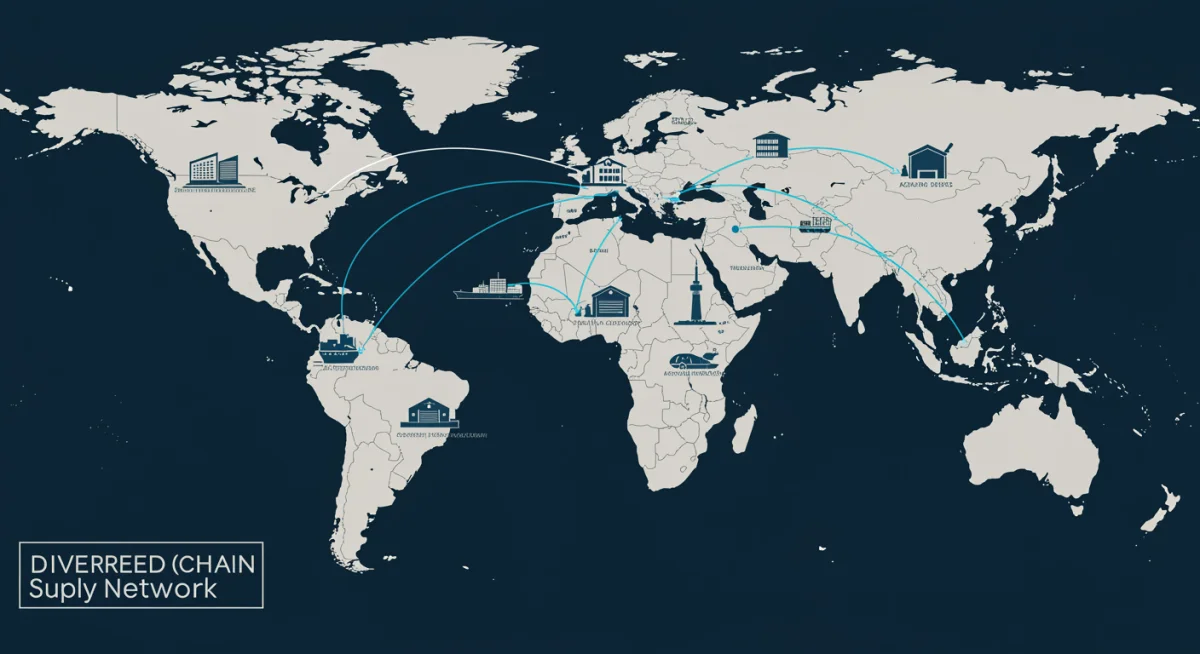
Diversification is not merely about finding alternative suppliers; it involves a holistic re-evaluation of global operational footprints. This might mean investing in production capabilities in different geographical regions, cultivating relationships with a broader range of logistics providers, or developing redundant pathways for critical components and raw materials. The goal is to create a network that can absorb shocks without collapsing.
Strategies for Supply Chain Resilience
- Geographic Spreading: Distribute manufacturing, sourcing, and distribution across several countries or regions to avoid concentration risk.
- Supplier Redundancy: Cultivate relationships with multiple suppliers for critical inputs, ensuring that the failure or unavailability of one does not halt operations.
- Inventory Buffers: Maintain strategic reserves of essential goods and components to weather short-term disruptions.
Beyond supply chains, market access diversification is equally vital. Over-reliance on a single foreign market for revenue can expose a business to significant risks if that market becomes politically unstable or subject to trade restrictions. Exploring new emerging markets, strengthening presence in established stable economies, and developing robust e-commerce channels can help spread market risk. This dual approach to diversification creates a more robust and adaptable international business model.
Step 3: Strategic Diplomacy and Stakeholder Engagement
In an era of heightened geopolitical tensions, U.S. businesses cannot afford to operate in isolation. The third practical step involves engaging in strategic diplomacy and cultivating strong relationships with a wide array of stakeholders, both governmental and non-governmental. This proactive engagement can provide invaluable intelligence, facilitate problem-solving, and enhance a company’s social license to operate.
Strategic diplomacy extends beyond traditional lobbying efforts. It encompasses building trust and understanding with local communities, collaborating with international organizations, and engaging in transparent dialogue with host governments. Such engagement helps businesses navigate complex regulatory environments, understand local sensitivities, and even influence policy in a way that aligns with their long-term interests and ethical standards.
Building Effective Diplomatic Bridges
- Government Relations: Maintain open channels of communication with U.S. diplomatic missions, host country governments, and relevant international bodies to stay informed and advocate for business interests.
- Community Engagement: Invest in local communities through corporate social responsibility initiatives, fostering goodwill and reducing the likelihood of local opposition or unrest.
- Industry Alliances: Collaborate with other businesses and industry associations to present a united front on common challenges and share best practices for navigating geopolitical risks.
Furthermore, stakeholder engagement should also include internal communication. Ensuring that employees, especially those on the ground in foreign territories, understand the company’s geopolitical strategy and their role in it is crucial. Empowering local leadership with autonomy and supporting their networks can significantly enhance a company’s ability to adapt to fluid political situations. This multifaceted approach to diplomacy and engagement fosters an environment of mutual respect and cooperation, vital for stability abroad.
Step 4: Building Organizational Resilience and Adaptability
The final and overarching step for U.S. businesses is to cultivate deep organizational resilience and adaptability. This means embedding flexibility into corporate culture, operational processes, and technological infrastructure. It’s about creating a business that can not only withstand shocks but also pivot quickly in response to unforeseen geopolitical shifts, transforming challenges into opportunities.
Organizational resilience involves more than just having contingency plans; it’s about fostering a mindset of continuous learning and agility. This includes investing in employee training on cultural competency and crisis management, developing flexible financial structures, and leveraging advanced analytics to predict and respond to changes. The ability to adapt quickly can determine survival and growth in volatile environments.
Pillars of Organizational Resilience
- Agile Decision-Making: Empower local and regional teams with the authority and resources to make rapid decisions in response to localized geopolitical events.
- Financial Flexibility: Maintain diversified financial assets, access to multiple capital sources, and robust hedging strategies to mitigate currency and market volatility.
- Technological Agility: Adopt scalable and secure technological solutions that can be quickly reconfigured or relocated, and ensure robust cybersecurity measures to protect critical data and operations.
Ultimately, building resilience is an ongoing process that requires constant evaluation and refinement. It demands leadership that champions adaptability, encourages innovation in the face of adversity, and views geopolitical challenges not just as threats, but as catalysts for strategic evolution. By embracing these principles, U.S. businesses can transform their operations into robust, future-proof entities capable of thriving amidst global uncertainty.
Future-Proofing Your Business: Beyond 2026
While this guide focuses on practical steps for 2026, the underlying principles of geopolitical risk management extend far beyond a single year. The world will continue to evolve, presenting new challenges and opportunities. Therefore, U.S. businesses must integrate these strategies into their long-term corporate governance and strategic planning. This involves a commitment to continuous learning, foresight, and proactive adaptation.
The goal is not simply to survive geopolitical turbulence, but to leverage a deep understanding of global dynamics to gain a competitive advantage. Companies that master the art of navigating complex international relations will be better positioned to identify emerging markets, secure critical resources, and attract top talent globally. This forward-looking perspective ensures sustained growth and leadership in an ever-changing world.
Embracing a Continuous Improvement Model
- Regular Strategy Reviews: Conduct annual or bi-annual reviews of geopolitical risk assessments and adjust strategies based on new intelligence and evolving global conditions.
- Cross-Functional Collaboration: Foster strong collaboration between departments such as legal, finance, supply chain, and HR to ensure a holistic approach to risk mitigation.
- Investment in Expertise: Continuously invest in internal expertise and external advisory services specializing in international relations, political economy, and global risk.
In essence, future-proofing a business means embedding geopolitical awareness into its DNA. It requires a culture where risk is anticipated, flexibility is valued, and strategic partnerships are nurtured. By doing so, U.S. businesses can not only safeguard their international operations but also emerge stronger and more innovative in the face of future global complexities.
Case Studies: Lessons from Recent Geopolitical Shifts
Examining recent geopolitical events provides invaluable lessons for U.S. businesses. The trade disputes between the U.S. and China, the conflict in Ukraine, and various regional instabilities have all offered stark reminders of how quickly the operating environment can change. Companies that had already begun diversifying their supply chains or establishing local partnerships fared significantly better than those heavily reliant on single markets or routes.
For instance, the semiconductor industry, heavily concentrated in specific regions, experienced severe disruptions due to both geopolitical tensions and natural disasters. This led many tech giants to accelerate plans for ‘friend-shoring’ and reshoring, highlighting the tangible benefits of geographical diversification. Similarly, energy companies have had to rapidly adjust sourcing and distribution networks in response to sanctions and shifting alliances.
Notable Business Responses
- Tech Sector’s Reshoring: Several tech companies began exploring domestic or allied-nation manufacturing for critical components to reduce vulnerability to geopolitical shocks.
- Energy Market Realignments: Global energy firms rapidly reconfigured their supply routes and partnerships in response to international sanctions and changes in energy diplomacy.
- Consumer Goods Localisation: Some consumer brands increased local production and sourcing in specific markets to bypass trade barriers and reduce long-distance supply chain risks.
These case studies underscore that proactive planning and a willingness to invest in resilience are not theoretical exercises but practical necessities. Businesses that learn from these past disruptions and integrate these lessons into their future strategies will be demonstrably more robust. The ability to observe, adapt, and innovate in response to global events is a hallmark of successful international operations.
| Key Strategy | Brief Description |
|---|---|
| Risk Assessment | Proactive identification and modeling of geopolitical risks to operations and markets. |
| Supply Chain Diversification | Spreading sourcing and manufacturing across regions to reduce dependency and enhance resilience. |
| Strategic Diplomacy | Engaging with governments and stakeholders to build trust and navigate complex political landscapes. |
| Organizational Resilience | Cultivating flexibility in culture, operations, and technology for rapid adaptation to change. |
Frequently Asked Questions
Primary risks include escalating trade wars, technological rivalries, regional conflicts, and increased economic nationalism. These factors can disrupt supply chains, alter market access, and impose new regulatory burdens on international operations.
Scenario planning allows businesses to model various future geopolitical outcomes, such as new sanctions or conflicts. By developing responses for these hypothetical situations, companies can create proactive contingency plans, minimizing reactive decision-making and potential losses.
Diversification reduces over-reliance on single regions or suppliers, making businesses less vulnerable to disruptions caused by political instability, trade restrictions, or natural disasters. It builds resilience and ensures continuity of operations even when one part of the chain is affected.
Strategic diplomacy involves proactive engagement with host governments, local communities, and international organizations. This helps businesses navigate regulatory complexities, build trust, gain insights into local political climates, and influence policy in a constructive manner.
Building organizational resilience means fostering an agile culture, empowering local teams for rapid decision-making, ensuring financial flexibility, and adopting adaptable technological solutions. It’s about creating a business that can quickly pivot and innovate in response to unforeseen events.
Conclusion
The imperative for U.S. businesses to actively navigate and mitigate geopolitical tensions in 2026 is undeniable. By systematically implementing robust risk assessment, diversifying supply chains and market access, engaging in strategic diplomacy, and fostering deep organizational resilience, companies can transform potential vulnerabilities into strategic strengths. These four practical steps are not merely defensive measures; they are foundational pillars for sustained growth, innovation, and competitive advantage in an increasingly interconnected and unpredictable global economy. Embracing this proactive and adaptable approach will be the hallmark of successful international enterprises in the years to come.